
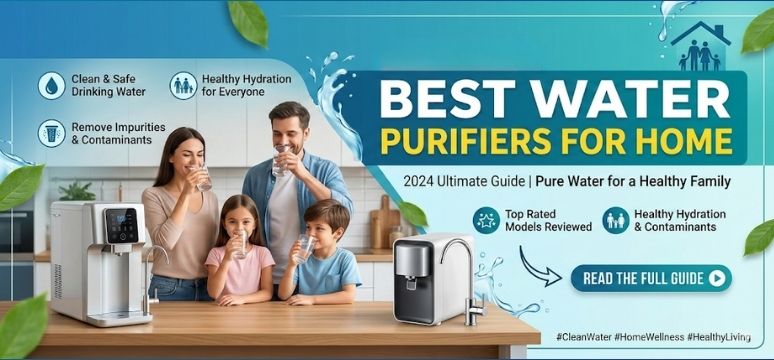
Clean drinking water is the foundation of a healthy home. With increasing water pollution, rising TDS levels, and contamination from industrial waste, households are rapidly shifting toward advanced water purification systems to ensure safe and hygienic drinking water. Choosing the best water purifier for home is no longer optional—it is a necessity for protecting your family from harmful bacteria, viruses, heavy metals, and dissolved impurities.
In this comprehensive guide, we explore the best water purifiers for home in 2026, examine the latest purification technologies, compare the most trusted brands, and provide detailed insights that help households make an informed purchasing decision. This guide focuses on RO, UV, UF, and alkaline water purification technologies, ensuring that every family can find the perfect purifier according to their water source and health requirements.
Why Every Home Needs a High-Quality Water Purifier
Water from municipal supply, borewells, or tankers often contains harmful contaminants such as lead, arsenic, bacteria, chlorine, pesticides, and high TDS levels. Consuming untreated water can lead to severe health issues including digestive infections, kidney problems, and long-term toxicity.
A modern home water purifier removes these contaminants using advanced filtration technologies that ensure every glass of water is pure, mineral-balanced, and safe for daily consumption.
Major Benefits of Installing a Water Purifier
-
Removes harmful bacteria and viruses
-
Reduces TDS and heavy metals
-
Improves taste and odor
-
Protects family health
-
Ensures consistent access to clean drinking water
-
Eliminates dependency on bottled water
A reliable water purifier provides long-term protection and convenience, making it one of the most valuable investments for any household.
Types of Water Purifier Technologies Explained
Understanding purification technologies helps households select the most effective system for their specific water conditions.
1. Reverse Osmosis (RO) Water Purification
RO technology removes dissolved salts, heavy metals, fluoride, arsenic, and other contaminants through a semi-permeable membrane.
Advantages
-
Ideal for high TDS water
-
Removes heavy metals and harmful chemicals
-
Produces crystal clear drinking water
Best For
-
Borewell water
-
Hard water sources
-
Areas with high TDS levels
2. Ultraviolet (UV) Water Purification
UV purification uses ultraviolet light to destroy bacteria, viruses, and microorganisms.
Advantages
-
Kills 99.99% of pathogens
-
Maintains natural mineral content
-
Requires low maintenance
Best For
-
Municipal water supply
-
Water with low TDS
3. Ultrafiltration (UF)
UF filtration uses a membrane-based process to remove suspended particles and microorganisms without electricity.
Advantages
-
Works without electricity
-
Removes bacteria and sediments
-
Low operating cost
Best For
-
Areas with low contamination
-
Homes requiring backup filtration
4. Alkaline and Mineralizer Technology
Modern purifiers now include mineral cartridges that restore essential minerals such as calcium and magnesium, improving water quality and taste.
Benefits
-
Balanced pH levels
-
Better hydration
-
Enhanced taste
Top 10 Best Water Purifiers for Home in 2026
Selecting the right purifier depends on purification technology, capacity, build quality, and maintenance costs. The following models represent the best-performing water purifiers for households.
1. Kent Supreme RO Water Purifier
The Kent Supreme RO purifier remains one of the most trusted options for households requiring multi-stage purification technology.
Key Features
-
RO + UV + UF + TDS control
-
8-liter storage tank
-
Automatic shut-off system
-
Wall-mounted design
Why It Stands Out
This purifier ensures maximum removal of dissolved impurities while retaining essential minerals, making it suitable for areas with high contamination levels.
2. Aquaguard Aura RO+UV Water Purifier
Aquaguard is one of the most recognized brands in water purification, and the Aura model combines advanced filtration with modern design.
Key Features
-
Active copper technology
-
7-stage purification
-
Mineral guard technology
-
Smart LED indicators
Why It Stands Out
The purifier enhances water quality with trace copper infusion, providing additional health benefits.
3. Livpure Glo RO+UV Water Purifier
The Livpure Glo purifier offers reliable purification combined with energy-efficient operation.
Key Features
-
RO + UV purification
-
Mineralizer technology
-
7-liter storage capacity
-
Smart indicator system
Why It Stands Out
It provides excellent purification at an affordable price, making it ideal for budget-conscious households.
4. HUL Pureit Copper+ Mineral RO Water Purifier
This purifier integrates copper infusion technology with multi-stage filtration to improve immunity and overall health.
Key Features
-
Copper-enriched water
-
7-stage purification
-
High water storage capacity
-
Smart auto-clean function
Why It Stands Out
It ensures powerful purification with added mineral benefits, ideal for families prioritizing health.
5. AO Smith Z9 RO Water Purifier
AO Smith is known for premium build quality and advanced filtration systems.
Key Features
-
Hot and ambient water options
-
RO + SCMT purification
-
Digital display panel
-
Large storage tank
Why It Stands Out
This purifier combines luxury features with superior purification performance.
6. Blue Star Aristo RO+UV Water Purifier
Blue Star offers efficient purification combined with modern aesthetics.
Key Features
-
Triple-layer protection
-
Mineral enhancer
-
Smart child lock
-
Elegant design
Why It Stands Out
It ensures consistent purification with stylish design suitable for modern kitchens.
7. Faber Galaxy Plus RO+UV Water Purifier
Faber integrates European engineering with efficient purification technology.
Key Features
-
9-stage purification
-
UV sterilization
-
Mineral guard technology
-
Compact design
Why It Stands Out
It provides high-level purification in a compact unit.
8. Havells Max Alkaline Water Purifier
Havells focuses on alkaline water technology to promote better hydration and health.
Key Features
-
8-stage purification
-
Alkaline water enhancement
-
Mineral cartridge
-
Zero splash dispensing
Why It Stands Out
It delivers balanced alkaline water for improved wellness.
9. Urban Company Native RO Water Purifier
Urban Company introduced a purifier designed for low water wastage and minimal maintenance.
Key Features
-
Smart purification technology
-
2-year service coverage
-
High water recovery rate
-
Sleek modern design
Why It Stands Out
It reduces water wastage while maintaining high purification standards.
10. Tata Swach Smart Gravity Water Purifier
For homes requiring electricity-free purification, Tata Swach offers a gravity-based solution.
Key Features
-
Nano filtration technology
-
15-liter capacity
-
No electricity required
-
Low maintenance cost
Why It Stands Out
It provides safe drinking water even during power outages.
Water Purifier Comparison Table
| Water Purifier | Technology | Storage Capacity | Ideal Water Type |
|---|---|---|---|
| Kent Supreme | RO + UV + UF | 8 Liters | High TDS |
| Aquaguard Aura | RO + UV | 7 Liters | Mixed water |
| Livpure Glo | RO + UV | 7 Liters | Borewell |
| HUL Pureit Copper | RO + UV | 8 Liters | Hard water |
| AO Smith Z9 | RO + SCMT | 10 Liters | High TDS |
| Blue Star Aristo | RO + UV | 7 Liters | Municipal |
| Faber Galaxy | RO + UV | 9 Liters | Borewell |
| Havells Max | RO + Alkaline | 7 Liters | Mixed |
| Urban Company Native | RO | 8 Liters | Municipal |
| Tata Swach | Gravity | 15 Liters | Low TDS |
How to Choose the Best Water Purifier for Your Home
Selecting the right purifier requires evaluating multiple factors.
1. Water Source
Determine whether your water comes from:
-
Municipal supply
-
Borewell
-
Tanker water
High TDS sources require RO purification.
2. TDS Levels
Use a TDS meter to determine water quality.
| TDS Level | Recommended Technology |
|---|---|
| 0 – 200 | UV / UF |
| 200 – 500 | RO + UV |
| 500+ | RO |
3. Storage Capacity
Choose a purifier with storage based on family size.
-
Small families: 6–7 liters
-
Medium families: 7–10 liters
-
Large families: 10+ liters
4. Maintenance Cost
Consider filter replacement frequency and service costs.
Most purifiers require annual servicing.
Maintenance Tips for Long-Lasting Water Purifiers
Maintaining your purifier ensures consistent performance and water safety.
Best Practices
-
Replace filters every 6–12 months
-
Clean storage tank regularly
-
Monitor TDS levels
-
Schedule annual servicing
-
Use original spare parts
Proper maintenance guarantees safe drinking water and extended purifier lifespan.
Advantages of Using Modern Water Purifiers
Modern purification systems offer multiple advantages beyond basic filtration.
Key Advantages
-
Advanced multi-stage filtration
-
Improved mineral balance
-
Better taste and odor
-
Energy-efficient technology
-
Smart monitoring systems
These features ensure households receive clean, safe, and great-tasting drinking water every day.
Future Trends in Water Purification Technology
The water purification industry is evolving rapidly with innovations focused on sustainability and smart monitoring.
Upcoming Innovations
-
AI-powered purification systems
-
Real-time water quality monitoring
-
Low water wastage RO systems
-
Smart mobile app integration
-
Eco-friendly filtration cartridges
These technologies will redefine how households access safe drinking water in the coming years.
Final Thoughts
A high-quality water purifier is an essential appliance for modern homes. By combining advanced purification technology, mineral balance, and reliable filtration, households can ensure safe drinking water for daily consumption.
Choosing the right purifier depends on water source, TDS levels, storage capacity, and maintenance requirements. Investing in a trusted purifier protects your family’s health while providing consistent access to clean and refreshing drinking water.
FAQs
1. What is the best water purifier for home use?
-
RO+UV water purifiers provide the most comprehensive purification.
2. Which purifier is best for high TDS water?
-
RO water purifiers are ideal for high TDS levels.
3. Do water purifiers remove bacteria?
-
Yes, UV and UF technologies eliminate bacteria and viruses.
4. How often should filters be replaced?
-
Typically every 6–12 months.
5. Is RO water safe to drink daily?
-
Yes, especially when combined with mineralizer technology.
6. Which purifier works without electricity?
-
Gravity-based purifiers like Tata Swach.
7. What is the ideal storage capacity for families?
-
7–10 liters for average households.
8. Do water purifiers improve taste?
-
Yes, purification removes chlorine and impurities.
9. What is TDS in water?
-
Total Dissolved Solids representing dissolved minerals and salts.
10. Is alkaline water better?
-
It helps maintain balanced pH levels and hydration.
11. Can RO remove heavy metals?
-
Yes, RO removes lead, arsenic, and mercury.
12. Are UV purifiers enough for municipal water?
-
Often yes, if TDS is low.
13. How much water does RO waste?
-
Modern systems reduce wastage significantly.
14. Can purifiers remove viruses?
-
UV technology destroys viruses effectively.
15. Do purifiers remove pesticides?
-
RO membranes remove chemical contaminants.
16. Are mineral cartridges necessary?
-
They help restore essential minerals.
17. How long do RO membranes last?
-
Usually 2–3 years.
18. What is multi-stage purification?
-
A combination of RO, UV, UF, and carbon filtration.
19. Are smart water purifiers worth it?
-
Yes, they provide real-time monitoring and alerts.
20. Can purifiers work during power cuts?
-
Storage tanks ensure continuous access to water.
21. Are water purifiers expensive to maintain?
-
Maintenance costs are moderate and manageable.
22. Do purifiers reduce hardness?
-
RO systems remove hardness minerals.
23. How long does purification take?
-
Most systems purify water instantly during dispensing.
24. Can RO water be used for cooking?
-
Yes, it is safe and ideal for cooking.
25. What is the lifespan of a water purifier?
-
Typically 5–10 years with proper maintenance.
For more information and to start using Roobae.com, visit our official website and download the app to stay updated on the best deals and offers. With Roobae.com, you can ensure that every shopping experience is not just an opportunity to shop but an opportunity to save big