
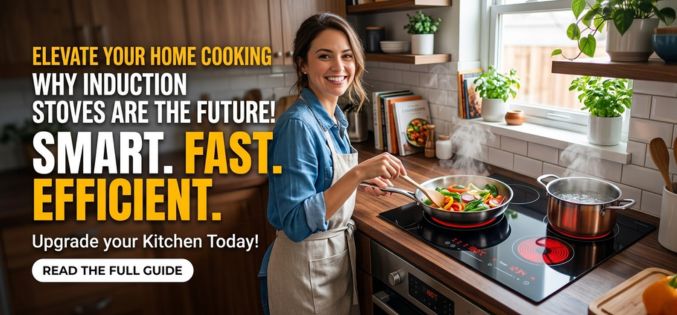
Modern kitchens are evolving rapidly, and induction stoves for home have become one of the most efficient, safe, and technologically advanced cooking solutions available today. With rising energy costs, increasing awareness about kitchen safety, and the growing demand for faster cooking methods, induction cooktops are transforming the way we prepare food.
In this comprehensive guide, we explore everything about induction stoves for home, including how they work, their advantages, how to choose the best one, maintenance tips, cooking techniques, and the most important factors to consider before buying.
What Is an Induction Stove for Home?
An induction stove is a modern cooking appliance that uses electromagnetic energy to directly heat cookware instead of heating the cooking surface itself.
Unlike traditional gas stoves or electric coil stoves, induction cooking works through magnetic induction, where an electromagnetic field generates heat directly inside compatible cookware.
Key Characteristics of Induction Stoves
-
Fast heating technology
-
Energy-efficient cooking
-
Precise temperature control
-
Cool-to-touch surface
-
Compact and modern design
Because the heat is generated directly in the cookware, induction stoves cook food faster and waste less energy compared to traditional cooking methods.
How Induction Stoves Work
Understanding the working principle of induction stoves helps homeowners appreciate their efficiency and performance.
The Induction Cooking Process
-
Electricity flows through a copper coil under the cooktop surface.
-
This creates a magnetic field.
-
When compatible cookware is placed on the surface, the magnetic field induces electric currents inside the cookware.
-
These currents generate instant heat, cooking the food directly.
Why the Surface Stays Cool
The cooktop itself does not generate heat. Only the cookware heats up, which means:
-
The surface remains relatively cool
-
Less heat is wasted
-
Kitchen temperature stays comfortable
Benefits of Using an Induction Stove at Home
1. Faster Cooking Performance
One of the biggest advantages of induction cooking is speed.
Induction stoves can boil water 50% faster than gas stoves because heat is transferred directly to the pot without energy loss.
Examples:
| Cooking Task | Gas Stove | Induction Stove |
|---|---|---|
| Boiling 1 liter water | 6–8 minutes | 2–3 minutes |
| Heating milk | 5 minutes | 2 minutes |
| Frying vegetables | 7 minutes | 4 minutes |
This efficiency saves both time and electricity.
2. Superior Energy Efficiency
Induction cooktops convert about 85–90% of energy into heat, whereas gas stoves convert only 40–55%.
Energy Efficiency Comparison
| Cooking Method | Efficiency |
|---|---|
| Gas Stove | 40–55% |
| Electric Coil | 65–70% |
| Induction Stove | 85–90% |
This makes induction stoves one of the most energy-efficient cooking solutions for modern homes.
3. Enhanced Safety Features
Safety is one of the strongest reasons many households switch to induction cooking.
Built-in Safety Mechanisms
-
Auto shut-off
-
Pan detection technology
-
Child lock system
-
Overheat protection
-
Spill detection
Since there is no open flame, the risk of gas leaks and fire accidents is significantly reduced.
4. Easy Cleaning and Maintenance
Induction stoves feature flat glass surfaces, making cleaning extremely easy.
Unlike gas stoves that accumulate grease and food debris around burners, induction surfaces require only a simple wipe with a cloth.
Cleaning Steps
-
Turn off the cooktop
-
Allow it to cool slightly
-
Wipe with a damp microfiber cloth
-
Use a mild cleaner for stubborn stains
This simplicity makes induction cooktops ideal for busy households and modern kitchens.
Types of Induction Stoves for Home
Different households have different cooking requirements. Induction stoves are available in several configurations.
1. Portable Induction Cooktops
These are the most common models used in homes.
Features include:
-
Lightweight and compact
-
Ideal for small kitchens
-
Easy to move and store
-
Affordable price range
Perfect for:
-
Students
-
Small apartments
-
Travel cooking
-
Backup cooking solution
2. Built-in Induction Cooktops
These are installed directly into the kitchen countertop.
Advantages include:
-
Premium appearance
-
Multiple cooking zones
-
Advanced touch controls
-
Smart cooking functions
Ideal for modern modular kitchens.
3. Double Burner Induction Stove
Double induction stoves allow simultaneous cooking of multiple dishes.
Key benefits:
-
Saves time
-
Ideal for families
-
Efficient meal preparation
Features to Look for When Buying an Induction Stove
Choosing the right induction stove requires understanding key features.
1. Power Consumption
Most induction cooktops operate between 1200W to 2000W.
Higher wattage means:
-
Faster cooking
-
Better heat control
However, ensure your home electrical system supports the power requirement.
2. Cooking Modes
Modern induction stoves include preset cooking modes such as:
-
Fry
-
Boil
-
Steam
-
Grill
-
Slow cook
-
Pressure cook simulation
These features make cooking simpler and more automated.
3. Temperature Control
Precision temperature settings allow accurate cooking.
Temperature ranges typically vary between:
-
60°C to 240°C
This flexibility is ideal for recipes requiring precise heat levels.
4. Timer Function
Timer controls enable users to set cooking durations.
Advantages:
-
Prevents overcooking
-
Saves energy
-
Allows multitasking
5. Pan Detection Technology
Induction cooktops only operate when compatible cookware is placed on the surface.
This prevents unnecessary energy consumption and enhances safety.
Compatible Cookware for Induction Stoves
Not all cookware works on induction stoves.
Suitable Materials
-
Cast iron
-
Magnetic stainless steel
-
Enamel-coated iron
Unsuitable Materials
-
Aluminum
-
Glass
-
Copper
-
Ceramic (unless induction compatible)
Simple Compatibility Test
Place a magnet on the base of cookware:
-
If it sticks → induction compatible
-
If it doesn't stick → not compatible
Best Cooking Practices for Induction Stoves
To maximize the benefits of induction cooking, follow these tips.
Use Flat-Bottom Cookware
Flat-bottom pans ensure maximum contact with the cooktop, improving efficiency.
Avoid Empty Heating
Running the induction stove without cookware may trigger automatic shutdown.
Use Proper Power Settings
Use low power for simmering and high power for boiling.
Keep Cooktop Clean
Food particles can affect heat transfer and reduce efficiency.
Induction Stove vs Gas Stove
Many homeowners wonder whether induction cooking is better than gas cooking.
Comparison Table
| Feature | Gas Stove | Induction Stove |
|---|---|---|
| Heating Speed | Medium | Very Fast |
| Energy Efficiency | Low | High |
| Safety | Moderate | Very High |
| Cleaning | Difficult | Easy |
| Temperature Control | Manual | Precise |
Induction stoves offer superior efficiency, safety, and convenience, making them ideal for modern homes.
Common Myths About Induction Cooking
Myth 1: Induction Cooking Is Dangerous
Reality: Induction cooking is actually safer than gas cooking because there is no open flame.
Myth 2: Food Tastes Different
Reality: The taste of food remains exactly the same because heat is simply a cooking medium.
Myth 3: Induction Stoves Use Too Much Electricity
Reality: Due to their efficiency, induction stoves often consume less energy than traditional stoves.
Maintenance Tips for Induction Stoves
Proper maintenance ensures long-lasting performance.
Daily Maintenance
-
Wipe surface after cooking
-
Remove spills immediately
-
Use soft cloths
Monthly Maintenance
-
Inspect power cables
-
Clean ventilation areas
-
Check control panel responsiveness
Avoid:
-
Abrasive cleaners
-
Metal scrubbing pads
-
Heavy impacts on the glass surface
Advantages of Induction Cooking for Modern Homes
Induction cooking aligns perfectly with modern lifestyle needs.
Major advantages include:
-
Faster meal preparation
-
Reduced energy consumption
-
Cleaner kitchen environment
-
Advanced cooking technology
-
Compact kitchen design compatibility
These benefits make induction cooktops one of the best kitchen upgrades for contemporary households.
Cost of Induction Stoves
The price of induction stoves varies depending on features and design.
Price Range
| Type | Price Range |
|---|---|
| Portable Induction | $25 – $80 |
| Double Induction | $80 – $150 |
| Built-in Induction | $200 – $800 |
Although the initial investment may be higher than basic gas stoves, long-term energy savings make induction cooking cost-effective.
Future of Induction Cooking
With technological advancements, induction stoves are becoming even smarter.
Emerging innovations include:
-
Smart app control
-
AI cooking assistance
-
Voice-controlled cooking
-
Smart temperature sensors
These innovations will continue to transform kitchens into fully automated smart cooking environments.
Conclusion
The induction stove for home represents a major evolution in cooking technology. With unmatched energy efficiency, enhanced safety features, faster cooking performance, and modern design, induction cooktops are becoming the preferred choice for homeowners around the world.
Whether you are upgrading your kitchen or looking for a compact and efficient cooking solution, induction stoves offer the perfect balance of convenience, safety, and performance.
FAQs
1. What is an induction stove?
An induction stove is a cooking appliance that uses electromagnetic energy to heat cookware directly.
2. Is induction cooking safe?
Yes. It is safer than gas because there is no open flame.
3. Does induction cooking save electricity?
Yes. Induction stoves are highly energy-efficient.
4. Can all utensils be used on induction stoves?
No. Only magnetic cookware works.
5. Do induction stoves heat faster?
Yes. They heat significantly faster than gas or electric stoves.
6. Is induction cooking expensive?
Initial cost may be higher, but long-term savings are significant.
7. Can induction stoves boil water quickly?
Yes. Water boils in almost half the time compared to gas stoves.
8. Are induction cooktops portable?
Many models are portable and easy to move.
9. Do induction stoves require special wiring?
Most work with standard household electrical outlets.
10. Is induction cooking suitable for Indian cooking?
Yes. It works perfectly for frying, boiling, and simmering.
11. Can induction stoves replace gas stoves?
Yes. Many homes now rely entirely on induction cooking.
12. Do induction stoves make noise?
A mild fan noise may occur during operation.
13. Can induction cooktops crack?
They are durable but should be protected from heavy impacts.
14. Are induction stoves easy to clean?
Yes. The flat glass surface is very easy to clean.
15. Can induction cooktops overheat?
Most models include automatic overheating protection.
16. Do induction stoves work during power outages?
No. They require electricity.
17. Are induction stoves environmentally friendly?
Yes. They reduce energy waste and carbon emissions.
18. Can induction cooktops fry food?
Yes. They are excellent for frying.
19. Do induction stoves require maintenance?
Minimal maintenance is required.
20. How long do induction stoves last?
Most high-quality models last 8–12 years.
21. Can induction stoves cook rice?
Yes. Many models include rice cooking modes.
22. Do induction stoves work with pressure cookers?
Yes, if the pressure cooker is induction compatible.
23. Are induction stoves safe for children?
Yes. Most models include child lock features.
24. Can induction stoves cook large meals?
Yes. Double-burner models handle large cooking tasks easily.
25. Is induction cooking the future of kitchens?
Yes. It is widely considered the next-generation cooking technology.
For more information and to start using Roobae.com, visit our official website and download the app to stay updated on the best deals and offers. With Roobae.com, you can ensure that every shopping experience is not just an opportunity to shop but an opportunity to save big